
Policies
The project's one rule surface - tiered rules enforced on every run, from soft advice to a hard merge block.
In simple words
A policy is a rule your project enforces on every run. Something like “use a hyphen, not an em-dash”, or “never add console.log to source files”.
Policies belong to the project, not to one supervisor. The supervisor is the enforcer that carries them into review, so a rule holds whichever supervisor is on duty.
vibe ui opens the dashboard on 127.0.0.1:4317. Policies is its own row in the sidebar. Its header counts your advise, block and pending rules beside the engine rules loaded from disk, and a Guards tile reads 4/4 while all four hard guards are on. New policy opens the one authoring form.
Start at the advise tier, the default. Reach for block only when you want a merge stopped outright, because a blocked run needs you to come back to it.
The page is two columns, and only the left one is yours:
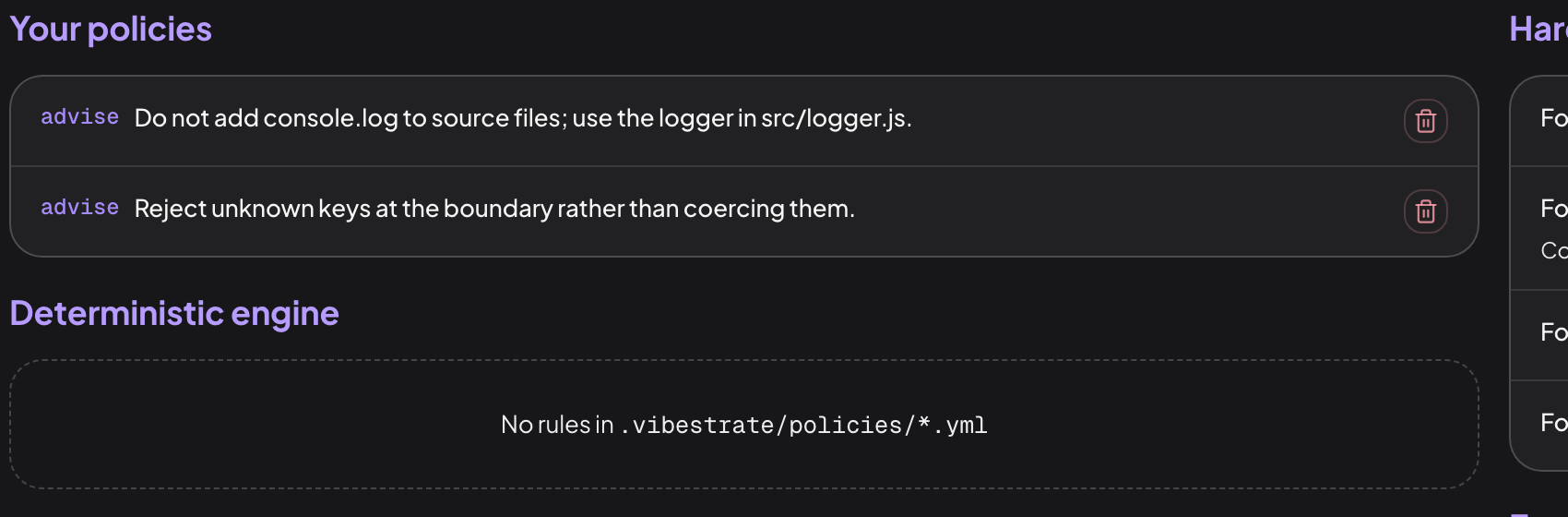
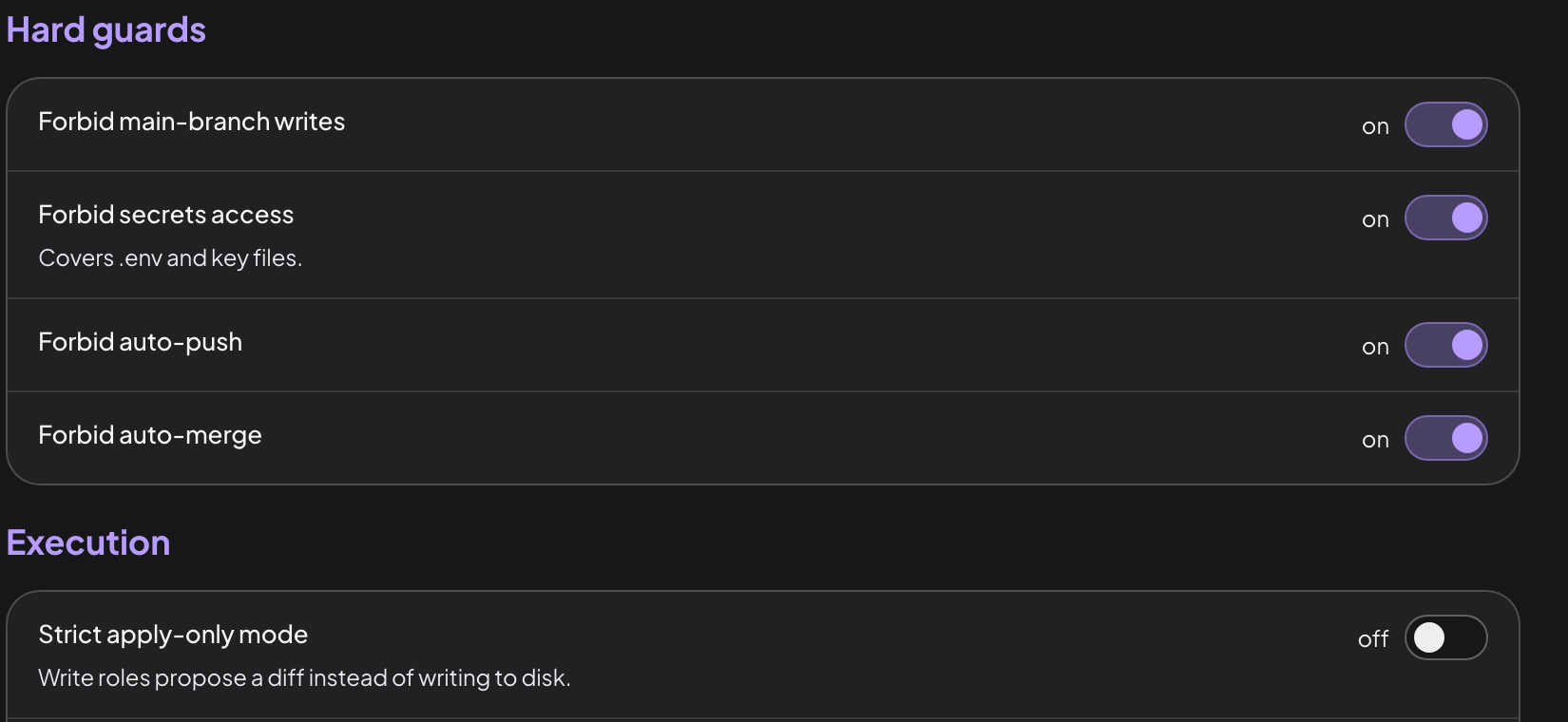
Your policies is what you author, and a fresh project starts with it empty. Deterministic engine under it is read-only: what the files in .vibestrate/policies/ currently contribute. On the right sit three switch groups and a patch checker, led by the four guards that ship on:
An advise rule is enforced by a model, and that is on purpose. A regex for “no em-dashes” is exact but brittle; a model generalises to the paraphrases a pattern would miss. block is the regex tier, which is why it only ever reads the lines a run added.
The tiers
advise - the default. The rule goes to both sides of the change. A violation written anyway is flagged and rides the normal review and fix loop. It never blocks a merge on its own.
block - a regex matched against the lines the run added, not a model verdict. On a match the run lands blocked with the reason shown, even if the reviewer approved. It scans from the run’s fork point, so mid-run commits are caught, and skips secret-like files. A diff it cannot read blocks rather than waves through.
A block is owner-only. The supervisor can propose an advise rule from a consult, never a hard block, and a proposal lands pending until you confirm it.
A broken block matcher stops the project, not the merge. No matcher, one over 256 characters, or one that is not a valid regular expression is refused when you write it and again every time project.yml loads, so the config fails with the reason rather than shipping a gate that looks armed. One that reaches the gate anyway is treated as inert and recorded as a supervisor.policy_block event. Dry-run a matcher from Test in the form, or with vibe policies test.
Writing one
New policy opens the one authoring form: a plain-English rule field, a Draft button beside it, and an advise / block picker. An advise rule takes an optional suggested fix, the correction the reviewer names when it flags the diff; a block rule takes a matcher regex and its flags. Add policy writes it, live on the next review with no confirm step, since you authored it. Each row underneath shows its tier and either its matcher or its stated fix.
Test opens Test this matcher, with Test snippet against pasted text and Test against recent runs; nothing is written and matched lines are redacted. A block row in the list carries the same test on its own flask button. Two shortcuts fill the same form: Draft turns your English sentence into a filled-in draft, and Suggest from recent runs reads recent diffs for candidates that Adopt prefills. A model may propose a tier and a matcher; committing a block stays your press of Add policy.
A rule the supervisor proposed
A rule the supervisor proposes sits at the top of your list tagged proposed, with Confirm and Reject on its row. The tier is fixed for that path: a proposed rule is always advise with no matcher, whatever the answer suggested.
Both sides see an advise rule
A code-writing seat is told the rules bind the code it is about to write, and to comply in this change, explicitly not to hunt for pre-existing violations elsewhere - so a policy does not quietly turn into a refactor. A reviewer is told to verify the diff against the same rules and flag every violation with its location and your stated correction.
The wording differs, the selection does not: a rule can never bind a writer without also being checkable by a reviewer, and an unconfirmed rule reaches neither. That matters for what a run costs, because a rule the writer never sees gets violated and then removed by a review, fix and re-review round trip.
A rule with no lens scope goes into every run; a lens-scoped one applies only when the run’s active review lenses include one it names. At most 12 rules reach a single turn, and anything past that is counted as dropped in the run’s supervisor.policy_advise event, so a long list thins out silently unless you read the event.
Soft rules and hard gates
Policies are the soft surface, owner conventions. Two harder things sit beside them on the same page.
The Deterministic engine card reads the content rules in .vibestrate/policies/*.yml, which gate patch content at apply time; those stay file-based and are not authored from the browser. The Hard guards group carries the four switches above, whose job is to declare the project’s invariants. Read that declaration narrowly: the snapshot carrying these flags has two readers, the dashboard’s project endpoint and the context consult is answered from, so the supervisor and the consult answerer see them and vibe doctor reads the config itself. A run’s implementer and reviewer seats never do.
Turning one off does not unlock the behaviour it names. Nothing pushes for you either way, nothing merges without an explicit human confirmation - the guided merge and vibe integrate refuse outright without it - and the secret-bearing-diff refusal runs regardless. What changes is that the supervisor is no longer told, and the Guards tile drops below 4/4.
A soft policy can only add a check, never relax one. Safety has the checkpoint all of this feeds.
Automation
The interactive shell (vibe, or vibe shell) has no policies screen; its Config page shows the resolved policy block read-only. Every action on the page has a vibe policies subcommand behind it, for scripting a rule into a setup or a repo template.
vibe policies add no-em-dash \
  "do not use em-dash characters" \
  --fix "use a hyphen"

vibe policies add no-eyebrow "no eyebrow labels" \
  --block --matcher "SectionEyebrow"

vibe policies test no-eyebrow --recent   # what would it block?
vibe policies list
vibe policies confirm <id>  # adopt a proposal
vibe policies reject <id>   # discard a proposal
vibe policies remove <id>
vibe policies draft "<rule in English>" and vibe policies suggest are the form’s two shortcuts, drafts only until you adopt one with policies add. vibe policies config carries the same switches as the three groups on the page, and vibe consult proposes a pending rule the same way the panel does.
A plain vibe run "<prompt>" needs zero policies; a project with none runs exactly as before. Earlier versions scoped these rules to a supervisor (personas.<id>.preferences); they are now project-level. On an older config, run vibe policies migrate once, or it fails to load with a message pointing you here.
